
Experiential Marketing Explained: Why Brand Experiences Deliver Better Customer Engagement
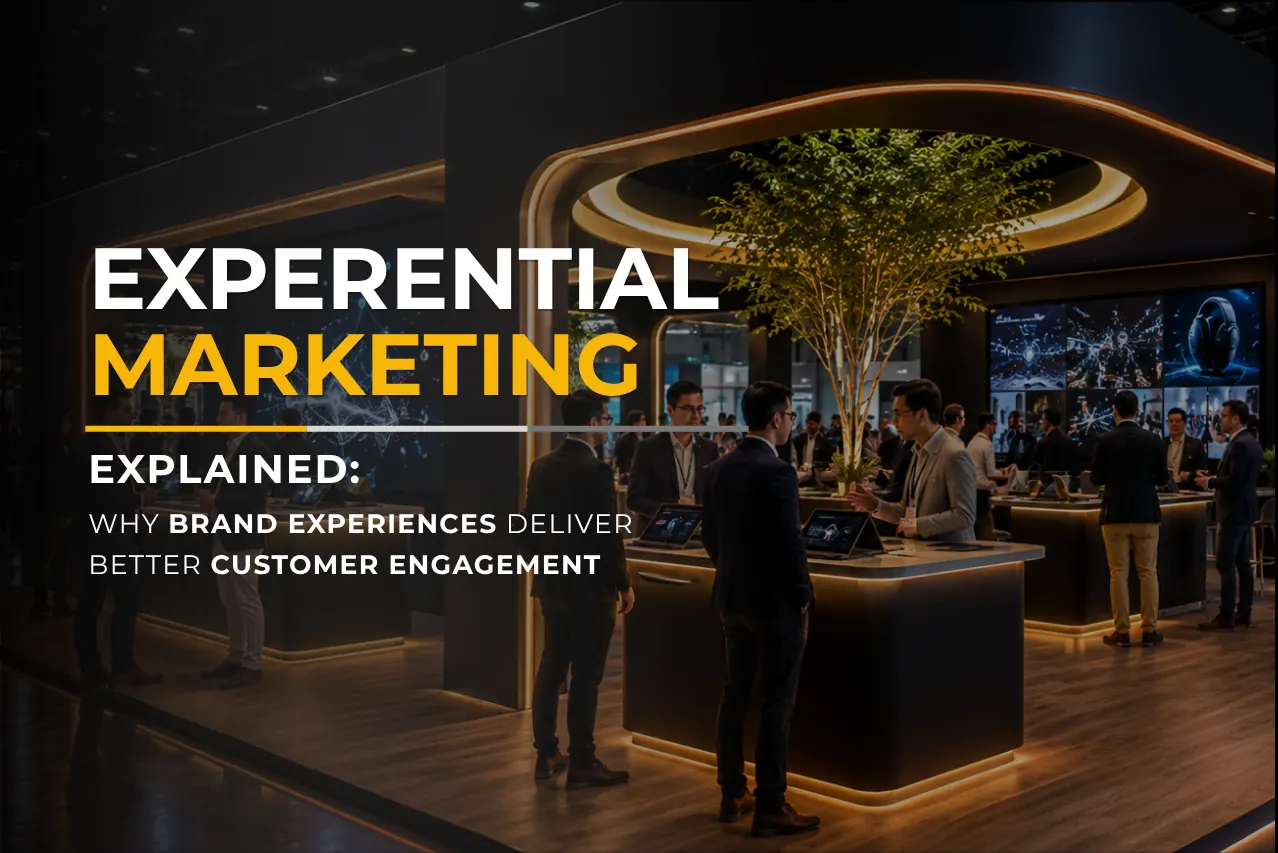
Experiential marketing is changing how brands connect with customers. Instead of simply showing people an advertisement or product, it gives them something to see, touch, try, explore or participate in.
That difference can turn passive attention into meaningful interaction.
From exhibitions and product launches to retail activations and corporate events, brands are increasingly using experiences to build stronger relationships with their audiences.
A 2026 EY-Parthenon and BookMyShow report found that 78% of surveyed Indian consumers prefer experiences over products, while 59% of live-event attendees recalled brands they engaged with on-ground. The research also found that 55% reported higher purchase intent after interacting with brands at events.
For marketing teams, the opportunity is clear: a well-designed experience can make a brand more memorable, understandable and engaging.
But experiential marketing is not simply about creating something visually impressive. It is about connecting strategy, creativity and execution around a clear customer and business objective.
What Is Experiential Marketing?
Experiential marketing is a strategy that allows people to actively interact with a brand rather than simply receive its marketing message.
It can include:
- Brand activations
- Product demonstrations
- Pop-up experiences
- Exhibition experiences
- Product launches
- Roadshows
- Interactive installations
- Retail experiences
- Immersive events
- AR and VR experiences
The basic principle is simple:
Don’t just tell people what your brand does. Give them a reason to experience it.
For example, a technology company can promote a new product through digital advertising. Or it can create an interactive demonstration where customers can try the product themselves.
The second approach gives customers an opportunity to understand the product through direct experience.
Why Experiential Marketing Works
People may forget an advertisement, but they are more likely to remember something they experienced.
1. It Turns Attention Into Participation
A strong visual can make someone stop.
An interactive experience gives them a reason to stay.
At a busy exhibition or event, this difference can have a significant impact on customer engagement.
2. It Makes Products Easier to Understand
Complex products are often difficult to explain through advertising.
Live demonstrations, simulations and product trials can make benefits easier to understand.
3. It Builds Emotional Connections
Experiences can create feelings such as:
- Curiosity
- Excitement
- Discovery
- Surprise
- Confidence
- Connection
These emotions can strengthen the way people remember a brand.
4. It Creates Shareable Content
A well-designed brand experience can continue beyond the venue.
Visitors may photograph it, create videos, share it on social media or discuss it with others.
5. It Creates Better Customer Conversations
For B2B brands, experiential marketing can move visitors from passive observation to meaningful sales conversations.
A product demonstration, for example, can help sales teams understand what a visitor needs and whether they are a qualified prospect.
Experiential Marketing vs. Brand Activation vs. Event Marketing
These terms are related but have different meanings.
| Term | Meaning |
| Experiential Marketing | Broader strategy focused on creating meaningful brand experiences |
| Brand Activation | A specific campaign designed to encourage brand interaction |
| Event Marketing | Using events as a marketing channel |
| Experiential Events | Events designed around participation and memorable experiences |
A brand activation can therefore be part of a broader experiential marketing strategy.
Similarly, an exhibition can use experiential marketing without the entire event being experiential.
Types of Experiential Marketing
Brand Activations
These bring brands directly into environments where their audiences spend time.
Examples include:
- Mall activations
- Retail activations
- Roadshows
- Sampling campaigns
- Campus activations
- Public-space installations
Product Launch Experiences
Product launches can go beyond stage presentations.
Brands can create:
- Interactive product zones
- Product demonstrations
- Immersive storytelling
- AR experiences
- Product trials
- Reveal moments
Pop-Up Experiences
Pop-ups create temporary branded environments for product discovery, awareness and engagement.
Exhibition Experiences
Exhibitions are particularly effective environments for experiential marketing.
Brands can use:
- Interactive demonstrations
- Product trial zones
- Gamification
- Digital displays
- AR/VR
- Consultation areas
- Live demonstrations
- Digital lead capture
The goal is to move visitors from seeing the booth to experiencing the brand.
Retail Experiences
Retail spaces can become experiential through:
- Product customisation
- Demonstration counters
- Interactive displays
- Sampling
- Digital experiences
How Experiential Marketing Improves Customer Engagement
A successful experience typically moves customers through several stages:
Attract → Engage → Understand → Connect → Act
For example, an exhibition visitor may first notice an interactive display, participate in a product demonstration, understand the product benefit, speak with a representative and finally request a meeting.
This makes customer engagement a journey rather than a single interaction.
Expert Tip: Before designing the experience, define what you want people to do after the interaction. Then design the experience backwards from that objective.
The Role of Storytelling
An experience should have a clear story.
Instead of displaying multiple product features, a brand can take visitors through:
Problem → Discovery → Interaction → Solution → Action
For example, a healthcare technology company could create a simulated patient journey to demonstrate how its platform works.
Visitors experience the problem, interact with the solution and understand its value.
The product story becomes an experience.
Technology in Experiential Marketing
Technology can make experiences more interactive, but it should always serve a purpose.
| Technology | Application |
| AR | Product visualisation |
| VR | Simulations and immersive demonstrations |
| Touchscreens | Product exploration |
| Projection Mapping | Storytelling |
| Interactive Games | Engagement |
| Digital Displays | Product education |
The right question is not:
“What technology can we add?”
It is:
“What problem will this technology solve?”
A simple product demonstration can often be more effective than expensive technology with no clear purpose.
Experiential Marketing at Exhibitions
Exhibitions are naturally suited to experiential marketing because visitors are already looking for products, services and solutions.
However, competition for attention is intense.
A booth displaying only logos, graphics and brochures may struggle to create meaningful engagement.
An experiential booth can include:
- Interactive product demonstrations
- Immersive brand zones
- Gamification
- Product trials
- Digital experiences
- Consultation areas
- Lead capture
- Social media moments
The objective is not to make the booth busy.
It is to create an intentional visitor journey.
How to Plan an Experiential Marketing Campaign
1. Define the Objective
Decide what the campaign needs to achieve:
- Generate leads
- Increase awareness
- Launch a product
- Drive trials
- Educate customers
- Increase retail footfall
- Build brand preference
2. Understand the Audience
Identify what your audience needs, what motivates them and what type of experience would be relevant.
3. Define the Experience
Ask:
What should people actually do?
This is often more important than asking how the setup should look.
4. Design the Customer Journey
Map the journey:
Attract → Engage → Explain → Interact → Convert → Follow Up
5. Plan Execution
Consider:
- Venue restrictions
- Fabrication
- Technology
- Manpower
- Electrical requirements
- Safety
- Installation
- Testing
- Dismantling
- Contingencies
Creative ideas only work when execution is reliable.
6. Define KPIs
Decide how success will be measured before the campaign begins.
How to Measure Experiential Marketing ROI
Footfall alone does not tell you whether an experience worked.
Awareness
- Reach
- Impressions
- Brand mentions
- Social reach
Engagement
- Participants
- Interactions
- Dwell time
- Product demonstrations
- Content shares
Lead Generation
- Leads generated
- Qualified leads
- Demo requests
- Meetings booked
Conversion
- Purchases
- Sales opportunities
- Revenue
- Cost per qualified lead
Brand Impact
- Brand recall
- Customer feedback
- Brand preference
- Sentiment
The right KPIs depend on the campaign objective.
Common Experiential Marketing Mistakes
1. Focusing Only on Visuals
A beautiful installation is not automatically an effective campaign.
2. Using Technology Without Purpose
Technology should improve the experience, not simply make it look advanced.
3. Making Participation Complicated
If people cannot understand what to do quickly, they may simply walk away.
4. Ignoring Customer Flow
Queues and bottlenecks can negatively affect the experience.
5. Collecting Unqualified Leads
High footfall does not necessarily mean high-quality prospects.
6. Forgetting Post-Event Follow-Up
The customer relationship should continue after the experience ends.
7. Failing to Measure
Without predefined KPIs, proving ROI becomes difficult.
Experiential Marketing Examples by Industry
FMCG
Sampling, retail activations, games and product trials can encourage discovery and purchase.
Automotive
Test drives, VR experiences and product demonstrations can make vehicle features more tangible.
Technology
Interactive demonstrations, AR/VR and consultation zones can simplify complex products.
Healthcare
Interactive education, demonstrations and patient-journey experiences can make information easier to understand.
Real Estate
VR walkthroughs, interactive master plans and immersive showrooms can help prospects visualise properties.
B2B & Industrial
Live machinery demonstrations, technical consultations and application-based product experiences can be highly effective at trade shows.
Experiential Marketing Trends
Experiences Are Becoming More Measurable
Brands increasingly want experiential campaigns connected to leads, trials, sales and customer data.
Physical and Digital Are Converging
Physical experiences can generate digital content before, during and after an event.
Personalisation Is Growing
Relevant and personalised experiences can create stronger audience connections.
Technology Is Becoming More Purposeful
Brands are moving away from technology for novelty and towards technology that improves interaction.
Experiences Are Becoming Full-Funnel
Experiential marketing is increasingly being used for awareness, engagement, lead generation and sales rather than awareness alone.
Quick Experiential Marketing Checklist
- Is the business objective clear?
- Is the target audience defined?
- Does the experience provide a reason to participate?
- Is the brand message clear?
- Is technology being used purposefully?
- Is the customer journey easy to understand?
- Are lead-generation mechanisms included?
- Are KPIs defined?
- Is post-event follow-up planned?
- Is there a production and contingency plan?
Conclusion
Customers are exposed to countless marketing messages every day.
The challenge is not simply getting noticed. It is creating enough relevance for people to stop, engage and remember.
That is where experiential marketing becomes powerful.
Whether it is an exhibition, product launch, retail activation or corporate event, the strongest experiences connect audience needs, brand storytelling and business objectives.
The best experience is not necessarily the biggest or most technologically advanced.
It is the one that gives people a reason to participate and leaves them with something worth remembering.
For brands, that requires more than creative thinking. It requires coordinated design, fabrication, technology, production and on-ground execution.
At Honeycomb Exhibits, this is where the strategic and execution sides of brand experiences come together—helping businesses translate ideas into physical experiences across exhibitions, events, activations and retail environments.
Ultimately, the question is not:
“How can we get people to see our brand?”
It is:
“What can we give them to experience, remember and talk about?”
That is the difference between being visible and being memorable.
Leave a Reply